

Facegenics Midface Expander
(FME)
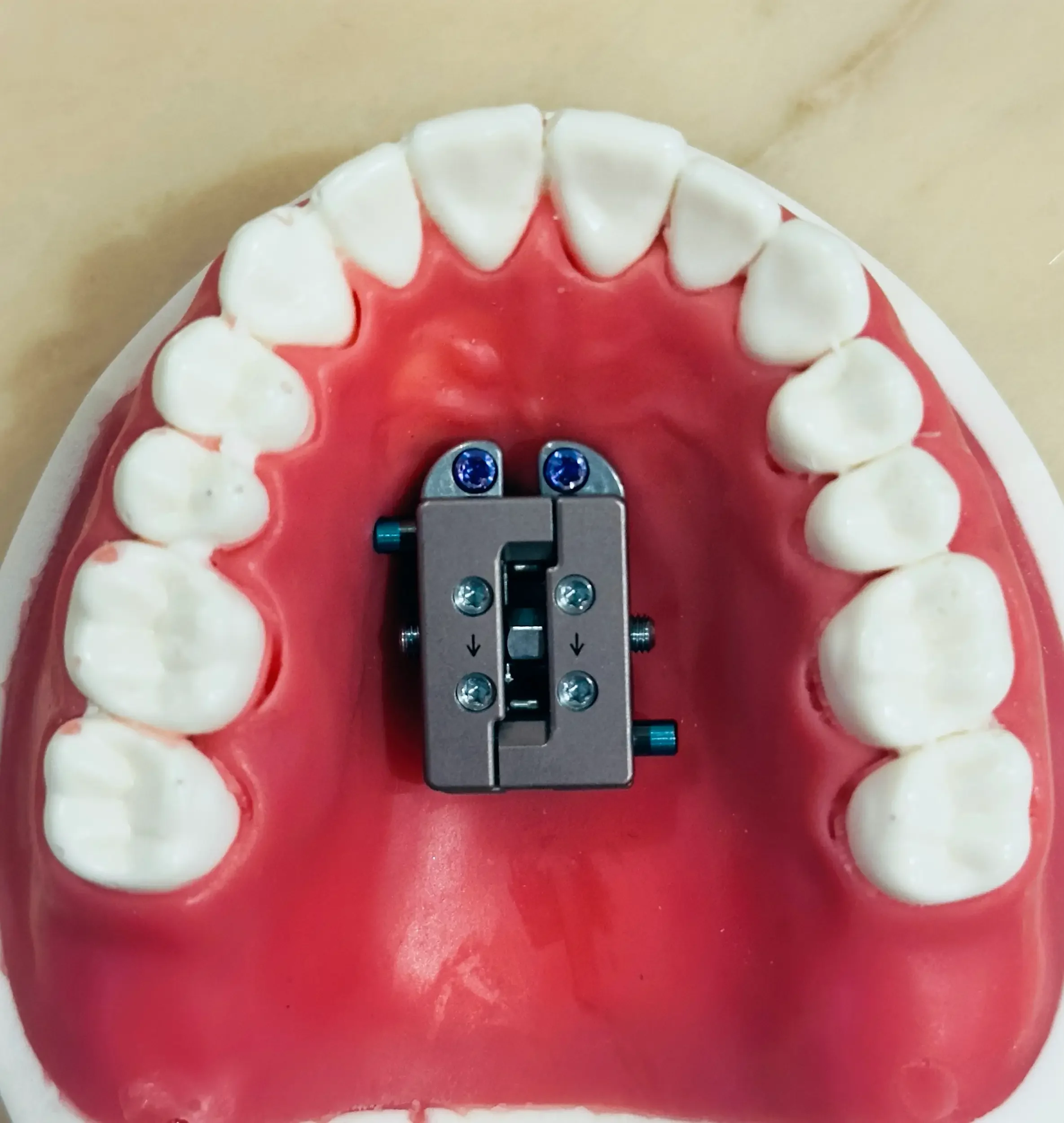
The Future of Airway Orthodontics

What is the FME Expander?
The Facegenics Midfacial Expander (FME) is a revolutionary adult skeletal expander designed to widen the upper jaw (maxilla) and improve airway function without surgery. Unlike traditional adult skeletal expanders that push against the teeth, the FME is a pure bone-borne appliance. It uses multiple revolutionary Locking Temporary Anchorage Devices (TADs)—specifically 6 to 10 micro-screws—customized to fit the palate of each individual patient with absolute precision. This unique design allows it to achieve adult maxillary skeletal expansion without tipping the teeth or causing dental side effects, making it an ideal solution for adults who have fully matured bones seeking a palatal expander. The latest version, the FME 4.5 expander, features a robust two-piece design that offers precise 3D control, allowing for not just widening, but also mid face expansion and advancement.
The FME Treatment Process
The FME procedure is a precise, multi-step journey designed for safety and stability.
Initial Consultation & Records: Your FME orthodontics provider will gather detailed data, including CBCT scans, intraoral scans, and photos to assess your bone density and anatomy.
Treatment Planning: A custom FME appliance is fabricated specifically for your mouth. For adults, this is often combined with the MARPEFACE™ protocol or specific piezocorticotomy to ensure the bone separates symmetrically.
Appliance Placement: The device is surgically placed and secured with TADs. You will then begin "activating" the device at home by turning a key as instructed to gradually expand maxilla width.
Stabilization: Once the target expansion is reached, the device remains in place for 6+ months. This critical phase allows new bone to fill the gap, ensuring the maxilla expansion before and after results are permanent.


It’s Finally Here…
Now offering FME 6-8-10 TAD
Protraction coming soon!
FME Expander Cost & Finding a Provider
The FME expander cost varies significantly by location and case complexity, generally ranging higher than traditional expanders due to the custom fabrication and 3D planning required.
Finding a provider can be challenging as this is a specialized technique. However, at Team Dental we are orthodontists who specialize in airway orthodontics and are certified Facegenics providers.
Before and After: What to Expect
Patients often seek FME expander before and after images to understand the potential changes. Clinically, you can expect:
Wider Smile: Elimination of dark corridors in the corners of your smile.
Improved Breathing: A noticeable increase in nasal airflow.
Facial Changes: Subtle forward projection of the cheekbones and better lip support.

BEFORE
AFTER

Frequently Asked Questions (FAQ) about FME Treatment
1. What is the Facegenics Midfacial Expander (FME)?
The Facegenics Midfacial Expander (FME) is a next-generation orthodontic device designed to widen the upper jaw (maxilla) in adults without surgery. Unlike traditional expanders that push against the teeth, the FME is a pure bone-borne appliance. It uses 6–10 Temporary Anchorage Devices (TADs)—small medical-grade titanium screws—to anchor directly into the palate. This allows for true skeletal expansion, improving the nasal airway and smile aesthetics without tipping the teeth.
2. How is FME different from MSE or MARPE?
While MSE (Maxillary Skeletal Expander) and MARPE (Miniscrew-Assisted Rapid Palatal Expander) also use TADs, they are often "hybrid" devices that attach to both the bone and the molar teeth.
MSE/MARPE: Can sometimes cause dental side effects like tooth tipping or gum recession because they rely partially on teeth for stability.
FME: Is designed to be 100% bone-borne. It does not touch the teeth, meaning all the expansion force is directed solely to the bone. This minimizes dental risks and allows for 3D control of the expansion.
3. Am I a candidate for FME?
Ideal candidates are typically adults or late teens who have:
A narrow palate or crossbite.
Obstructive Sleep Apnea (OSA) or chronic nasal congestion (mouth breathing).
Crowded teeth and want to avoid extractions.
A "flat" face profile (midfacial deficiency). Your provider will use a CBCT scan to evaluate your bone density and suture maturity to confirm if FME is safe for you.
4. Does the FME procedure hurt?
Most patients report pressure rather than sharp pain. The placement of the TADs is done under local anesthesia, so you shouldn't feel pain during the procedure. During the active expansion phase (turning the key), you may feel pressure in the nose, cheekbones, or between the eyes. This sensation typically subsides within 15–30 minutes. Over-the-counter pain relievers are usually sufficient for any soreness.
5. How long does FME treatment take?
The total treatment time generally ranges from 20 to 24 months, though the active expansion only happens in the first few months.
Active Phase: You turn the expander daily for 1–3 months until the desired width is achieved.
Stabilization Phase: The device must remain in place for 6+ months to allow new bone to regenerate in the gap. If removed too early, the expansion can relapse.
6. Will FME change my face?
Yes, most changes are positive. Patients often notice:
A wider, fuller smile with less "black space" in the corners.
Improved cheekbone contour (midfacial advancement).
Better lip support. However, in rare cases, if the expansion is asymmetrical, temporary facial asymmetry can occur, which is why working with a certified provider is critical.